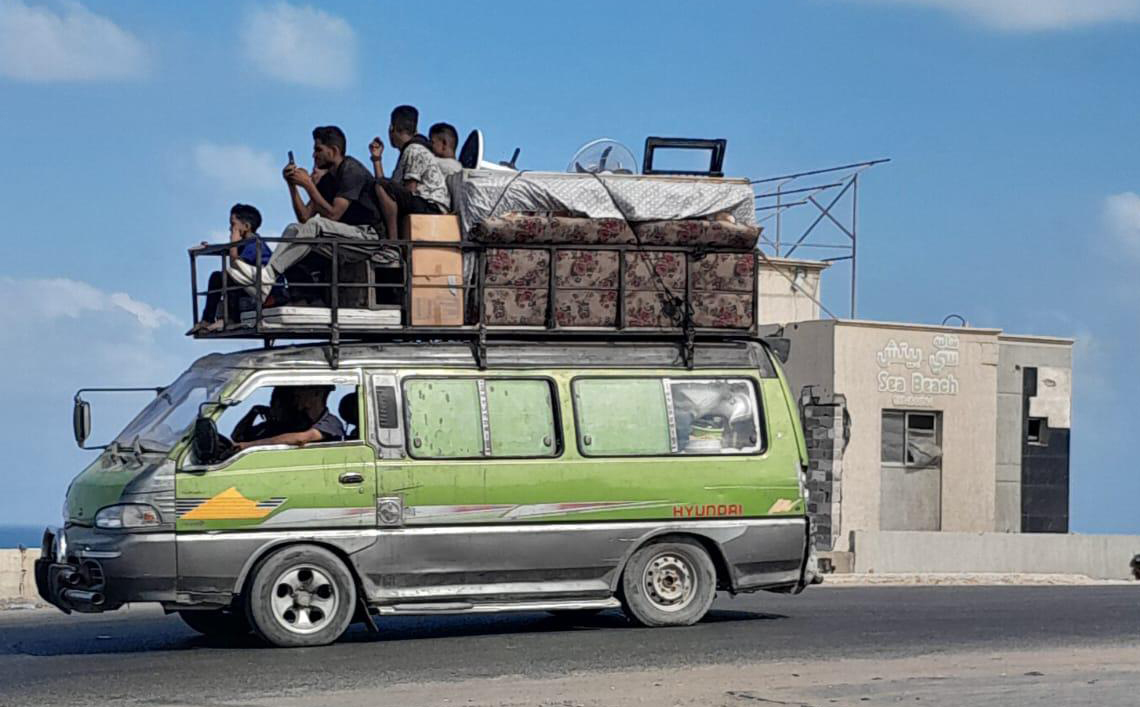
Between Staying and Displacement: An Analysis of Population Movements in the Gaza Strip (20–27 August 2025)
First: General Context
Between 23 and 27 August 2025, Gaza City and its surrounding areas witnessed a notable escalation in displacement movements, coinciding with artillery shelling, airstrikes, and an intensification of Israeli military operations in areas north of Wadi Gaza, including ground movements of military vehicles.
These developments directly affected population movement patterns, resulting in a combination of mass displacement, intermittent displacement, and reverse displacement, with some families returning to their original neighborhoods following periods of relative calm.
Second: Displacement Data
1. Relative Stability at the Beginning of the Period (20–24 August 2025)
- No large-scale displacement waves were recorded from Gaza City toward south of Wadi Gaza.
- The number of displaced persons moving south of Wadi Gaza reached 535 individuals on Friday, 22 August 2025, compared to 647 on Thursday, 21 August, and 394 on Wednesday, 20 August 2025.
- A significant proportion of displaced individuals returned to Gaza City on the same day after securing basic needs in southern areas.
- Observations indicate that the majority of residents displaced from high-risk areas (Al-Zeitoun, Al-Sabra, and Sheikh Radwan) moved toward western Gaza City, where many families rented apartments or commercial premises for longer-term accommodation.
2. Escalation of Displacement and Emergence of Reverse Movement (25 August 2025)
- Field data recorded the displacement of approximately 1,150 individuals from north of Wadi Gaza to the south.
- Simultaneously, reverse displacement movements were observed, with around 140 families returning to the Bir Al-Na‘ja area and 90 families returning to Jabalia Al-Nazla.
- As Israeli military vehicles advanced toward Al-Saftawi and Jabalia Al-Nazla, these areas experienced renewed displacement toward Sheikh Radwan and Al-Rimal, before the majority of families returned following a period of relative calm.
3. Large-Scale Mass Displacement (26–27 August 2025)
- A mass displacement estimated at approximately 2,400 families was recorded from the neighborhoods of Jabalia Al-Balad, Al-Nazla, and Al-Saftawi, in scenes described as harsh and harrowing, with families fleeing almost empty-handed, without food or water.
- Nearly half of these families moved westward toward Gaza City (tents, relatives’ and friends’ homes), while other groups sought refuge in Sheikh Ajlin, and hundreds of families moved south toward Wadi Gaza.
- Within this movement, the displacement of 1,135 individuals (approximately 227 families) from north of Wadi Gaza to the south was documented, most originating from officially designated evacuation zones, in addition to other displacement sites not yet directly targeted.
- Despite the scale of displacement, some families were also observed returning to their original areas following temporary calm, reflecting hesitation and divided decision-making regarding displacement.
Third: Analytical Observations
- The data indicate a clear reluctance among residents to relocate south of Wadi Gaza, with most preferring to remain in western Gaza City, northwestern areas close to truck access routes, or in the southwestern neighborhood of Sheikh Ajlin.
- Displacement toward the south remains limited relative to the level of risk, reflecting residents’ determination to stay as close as possible to their homes.
- The absorptive capacity of central and southern areas of the Gaza Strip remains extremely limited, particularly in terms of healthcare facilities, shelters, and infrastructure, posing the risk of a major humanitarian catastrophe should displacement waves expand.
- The situation cannot be characterized as stable or final displacement, but rather as a complex dynamic of repeated displacement and conditional return, dependent on temporary security conditions, underscoring the fragility of the humanitarian and security situation on the ground.
Fourth: Conclusion
Displacement movements during the period 20–27 August 2025 demonstrate a combination of mass displacement, limited displacement, and reverse displacement, occurring under harsh conditions and in the absence of any guarantees for civilian protection.
These patterns reflect the continued use of military pressure on the civilian population to force relocation, countered by a form of civilian resistance expressed through attempts to remain close to original homes and neighborhoods, despite the ongoing risks.